Sections

Showing posts with label Perception. Show all posts

Sunday, September 23, 2012

Conversion or Initiation

What do you believe in? Why do you believe it? Were you born into it or did you change your beliefs as you came upon it? Is it mutually exclusive of other viewpoints and beliefs, or is it inclusive and expansive with them? The two words: conversion and initiation used in a religious or spiritual context have subtle differences in meaning. They both usually refer to coming to a new religious system or belief, but they depart from there.

When I was first introduced to Hinduism, I was told it was something people can’t convert to. At the time my 20-something brain said to me, don’t tell me what I can and cannot do; I was put off. Whenever I’m told there is something I can’t do, my first reaction is gut-wrench abhorrence to the idea: why not? Whether the statement itself is true or not, the answer underlying it is rooted more in philosophy and perspective than mere facts. My current understanding is: you can’t convert to Hinduism, but you can initiate into it. The difference seems subtle, but the meaning is very important. (I’ll leave caste aside.)

Most of the dominant Western religions [Judaism, Catholicism, Islam] have a conversation aspect to them. You shed your previous beliefs and proclaim you now have taken on the new dogma. You are converted. You now believe what the others believe. Of course there are variances. Not all people from a religion are generic and believe the same things wholeheartedly, but the conversion takes place and in doing so you proclaim your faith in the new dogma and doctrines. The door closes on your past belief system. These systems are usually exclusive in their beliefs with the religion you converted into.

Saturday, September 15, 2012

Missing The Point: White Privilege Part 1

I was deeply saddened and angry by the Sikh Gurdwara (temple) shooting. I wrote the post I Wear a Kara in its wake. In the discussion that followed I understood that I didn’t quite fully achieve what I was hoping to.

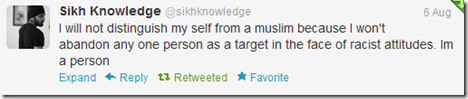
How did I go astray? I focused time and energy on how Sikh’s are different than Muslims, instead of focusing on the real problems: racism, hatred and misunderstanding. In my own case, I was stifled by my own blind spot: white privilege.

Sikh Knowledge Quote
Twitter user @sikhknowledge sums it up for me

I spent time in my post on how Sikh’s are different. I never should have gone there. I’d like to say we’re all the same: people, families, trying to survive, trying to pray, celebrate life. I want everyone to be treated as equals to the point that I force myself to believe we are all equals – even though we’re not.

I wish the world where a place where all men were treated the same; all women were treated the same as men; all religions were seen as paths of love and a celebration of life with one another: but the world is not that place. Sometimes I want it so bad I try to believe that all men are equal (and all the rest above): but then I get my white privilege blind spot. The world is not an equal place. Further, I’m in the top dominant, privileged position.

Monday, April 16, 2012

Does Our Intellect Detract From Spiritual Ecstasy?

This isn’t a plea for ignorance. No definitive conclusions have come to me. What I’m hoping for is open dialogue.

I have heard people say their heads get in the way of themselves. This leads me to wonder if we intellectualize ourselves out of the moment; the moment of being in the present and experiencing spiritual ecstasy, a mystical experience that requires a detachment of the intellectual self to be fully realized.

People have all kinds of spiritual experiences. Some may be sitting in meditation, experiencing nature, really good sex, playing music, making art, listening to music, appreciating art, swimming, flying, reading, writing, in a temple, riding a horse. Many experiences can be deemed as causing some transcendence to a much deeper meaning that comes with or without revelation – but you succinctly understand you were moved. You may not be able to explain how or the way you were moved – unless you’re explaining it to someone that has been there.

When these bouts of spiritual ecstasy come upon us, is it a removal of our intellect, our thinking that allows it to flow more freely? Do we need to detach our minds to open doorways to let that which is more than ourselves enter into us and course through us?

Wednesday, December 29, 2010

Action v. Intent

We’ve had a lot of discussion in our house on the subject of action v. intent. Intent is what we mean to do, what we mean to be doing, what we meant to do. It’s usually a pretty rosy picture, but it can also be delusional. Action is what we actually did. Action is the truth of ourselves. There is no coloring, rosy or otherwise. There is no meaning other than truth. It is what we do, what we did. There is no lie in who we are with action, although it may not paint us the way we wish to be seen.

I view my intent often through the lens of my ideal self – the person I think I am. I intend to be someone, so I think I am that person. But I’m actually who I am by the way I act, not the way I perceive myself. My actions often diverge from what I meant (my intent). It’s much harder to admit who I am using this value system. An example of this is donating to charity. I intend to do it more often than I actually do. I can go into so many different examples of how I see myself diverge from what I’m actually doing.